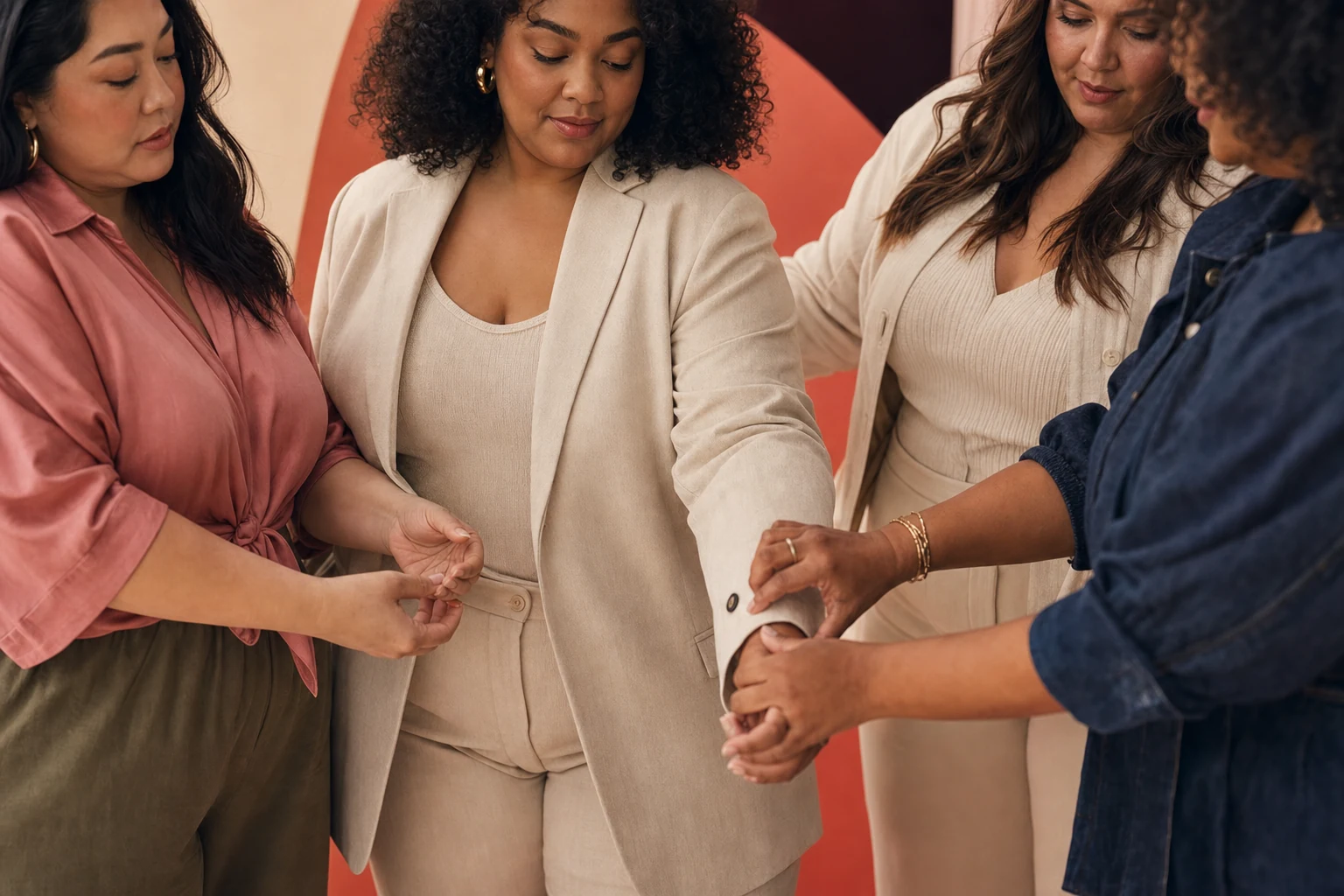
An hourglass figure already has a well-defined natural proportion between shoulders, waist and hips — color can accompany that line, not "fix" it. Once you understand how to use it deliberately, you have far more options than you might think.
Monochrome: elongates the whole figure
Wearing the same color (or very similar tones) from head to toe creates a continuous vertical line, visually elongating your figure without breaking up the silhouette midway. It works particularly well in dark or neutral tones, but a monochrome look in a bold shade like burgundy or emerald has just as strong a visual impact while keeping the same elongating effect.
A bold color at the waist, neutral elsewhere
A belt or top in a bolder shade right at the waist emphasizes the narrowest point of your body, highlighting the natural hourglass proportion. This principle also works with a neutral skirt or trousers paired with a colorful top: the effect is similar, with the added benefit of being easier to switch up for different looks.
Contrast between top and bottom: use it intentionally
A light top with dark trousers (or vice versa) creates a visual break at the waist — it works well if that's the effect you want, but keep in mind it "interrupts" the continuous line that monochrome creates instead. Neither approach is better or worse, they simply communicate a different energy: one more dynamic, one more uniform.
Warm and cool tones add another layer of choice
Beyond light-dark contrast, color temperature also plays a role: warm colors (red, orange, yellow) tend to visually "advance," while cool colors (blue, green, purple) tend to "recede." On an hourglass figure, you can use this property to further emphasize a specific area — a warm-toned top, for instance, to draw attention to the upper body.
How prints interact with these color principles
If you prefer a print over a solid color, the same logic applies: a denser or more vivid print at the waist (a printed belt, for example) creates the same emphasis effect as a bold solid color, while a print distributed across the whole garment behaves more like monochrome, elongating the figure as a whole.
Common mistakes to avoid
The first mistake is assuming there's only one "correct" color for an hourglass figure — in reality almost every color works, it just changes the effect produced. The second is ignoring the occasion entirely: an elegant dark monochrome might not be the right choice for a bright, casual event, regardless of how well it flatters the silhouette.
Building a small color "toolkit" for your wardrobe
Rather than buying pieces color by color as trends shift, it helps to settle on two or three core colors that you know flatter your hourglass proportions, then add seasonal accents around them. This makes getting dressed faster and means new purchases are more likely to actually get worn together instead of sitting unworn in the closet.
Considering skin tone alongside body shape
Body shape isn't the only factor worth thinking about — skin undertone changes how a color reads next to your face specifically, separate from how it flatters your silhouette. A warm-undertone complexion tends to glow in earthy reds and golden yellows, while a cool undertone often looks brighter in blues and true reds. Combining both considerations, body shape and undertone, gives you a more complete way to choose colors that work on every level.
Frequently asked questions
Does monochrome work with very light colors like white too?
Yes, an all-white monochrome has the exact same elongating effect as a dark one, with the difference that it communicates a fresher, brighter energy — particularly suited to summer.
Can I use three different colors in one outfit without losing the hourglass effect?
Yes, as long as one color remains dominant and the other two play a more secondary role (accessories, details). Three colors all carrying equal visual weight risks fragmenting the silhouette too much.
Do geometric prints work well on an hourglass figure?
Yes, especially vertical or diagonal prints, which follow the body's natural line nicely. Horizontal prints still work, but it's worth testing them based on exactly where they fall relative to the waist.
The bottom line
On an hourglass figure, monochrome elongates the length of your body, while a bold color at the waist emphasizes your natural proportion. Both strategies work — the choice depends on the effect you're going for that day and the occasion you're dressing for.
Discover colors and pieces in the CurvyIndex directory.